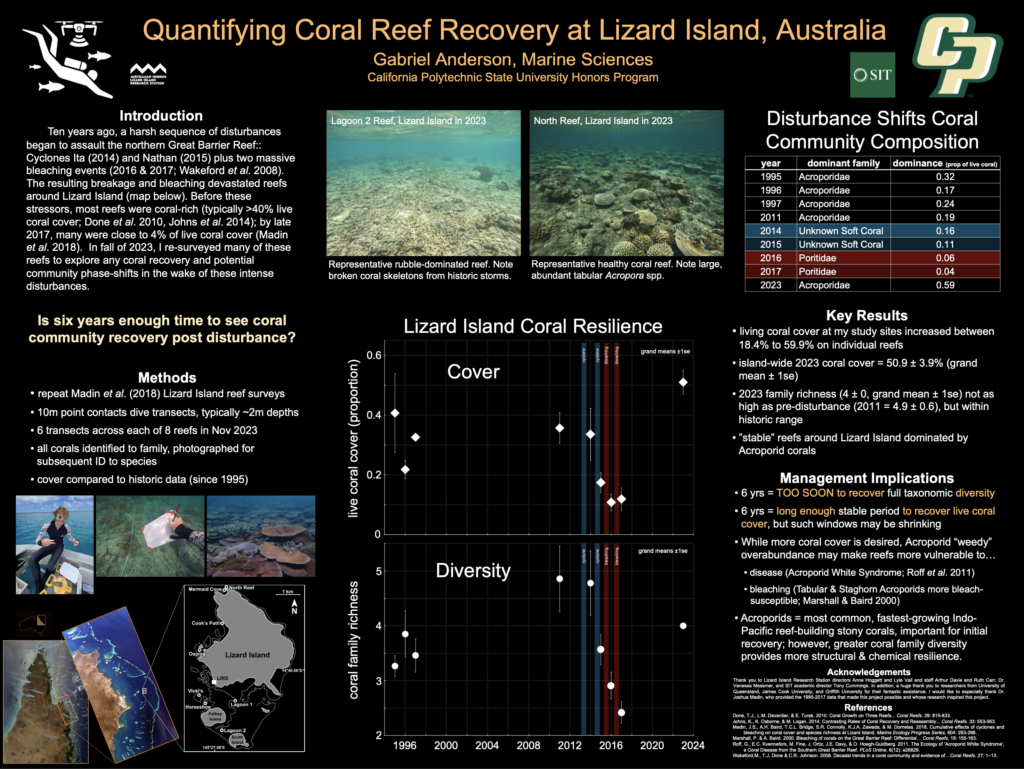
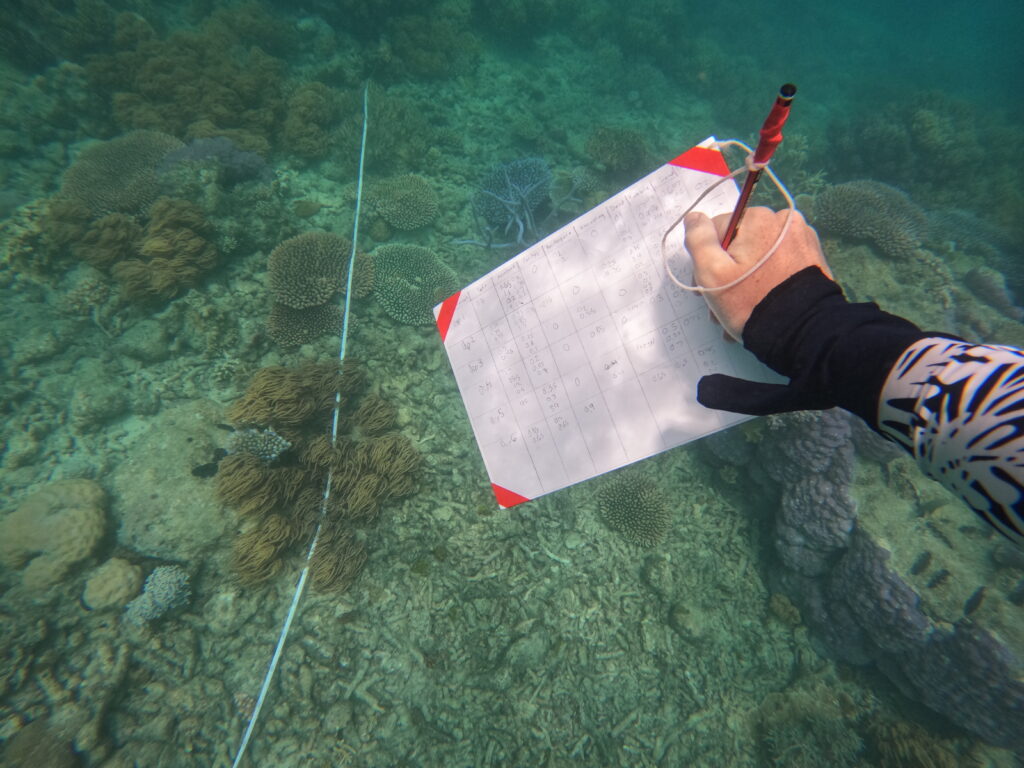
I attended the 2023 fall semester SIT: Rainforest, Reef, and Cultural Ecology program in Queensland, Australia. During my stay, I conducted a 6-week-long independent study project in which I applied and was accepted to perform research at Lizard Island Research Station on the northern Great Barrier Reef. My research project examined the recovery of hard coral families across eight reef sites surrounding Lizard Island. I took inspiration from Madin et. al, 2018, in which it was referenced that reefs weathered and bleached from by the end of 2017 would take 5-20 years to experience significant positive recovery (Done et al. 2010, Johns et al. 2014). My study was performed in 2023, 6 years after this prediction, and I was interested to see how the reefs’ condition may changed since that study. I underwent the process of getting my Australian boater license in order to use a small research vessel, and used six 10-meter line-intercept transects at each site to get a sense of percent cover of different substrate types and hard coral families present. I collected data from October 23rd–November 18th. You can find my study published here at Frontiers in Marine Science.
Coral reefs globally are experiencing more intense and frequent climate change-induced disturbances such as cyclones and bleaching events. The ecological significance of reef ecosystems makes it imperative that the effects of such disturbances are well-monitored as the global temperatures and weather patterns that influence them continue to fluctuate more erratically. From March of 2014 to May of 2017, the Lizard Island reefs in the northern region of the Great Barrier Reef experienced four consecutive disturbances–Cyclone Ita in 2014, Cyclone Nathan in 2015, and two massive bleaching events in 2016 and 2017. Between the intense patches of physical damage from the cyclones and the uniform impact of the bleaching events, these reefs were devastated, with none of the eight study sites reaching more than 20% coral cover by May of 2017. In November of 2023, after six years of relatively calmer conditions and less disturbances, coral cover at the study sites improved by various margins from 18.42% to 59.91%, with many sites on the higher end of that spectrum. There was a north-south trend in which more northerly sites had generally greater rates of recovery and total coral cover. Possible phase shifts at a select few southern sites likely resulted in their poorer recovery rates. Future annual surveys of the study sites as well as others surveyed in 2017 may better clarify the relationship between reef location and the rate of increase of coral cover. Feel free to browse this newsletter from Cal Poly’s Honor College detailing more about my coral research project (page 15).