
Coastal erosion is a growing problem in the western U.S., particularly in areas such as Southern California. Despite this growing problem, the public is generally unconcerned or uncertain about the necessity of particmanagement choices. Southern Californians view sea level rise as problematic, but don’t widely see (with ~⅔ unsure or neutral in any given year) managed retreat as a useful potential response to associated coastal erosion or inundation. We have been trying to quantify coastal erosion at specific sites across coastal Southern California to accurately capture and convey the rapid onset of this permanent environmental condition our society must come to terms with more frequently as it progresses.
Under the guidance of Dr. Kiki Patsch at CSU Channel Islands, this multi-year research project aims to capture and quantify the state of sea level rise and related geomorphological impacts across 52 sites (with more added on each year) along the Southern California Coast. The current range of sites reaches from the Guadalupe Dunes Preserve in northern Santa Barbara County to Manhattan Beach in Los Angeles County. The state of the beaches geomorphological structures are recorded using various DJI quadcopters coupled with Pix4D, a drone mapping and imagery processing software. Since 2020, I have been programming flights, piloting in the field, and processing the resulting imagery to add on to a previous four years of compiled data from a majority of these sites.
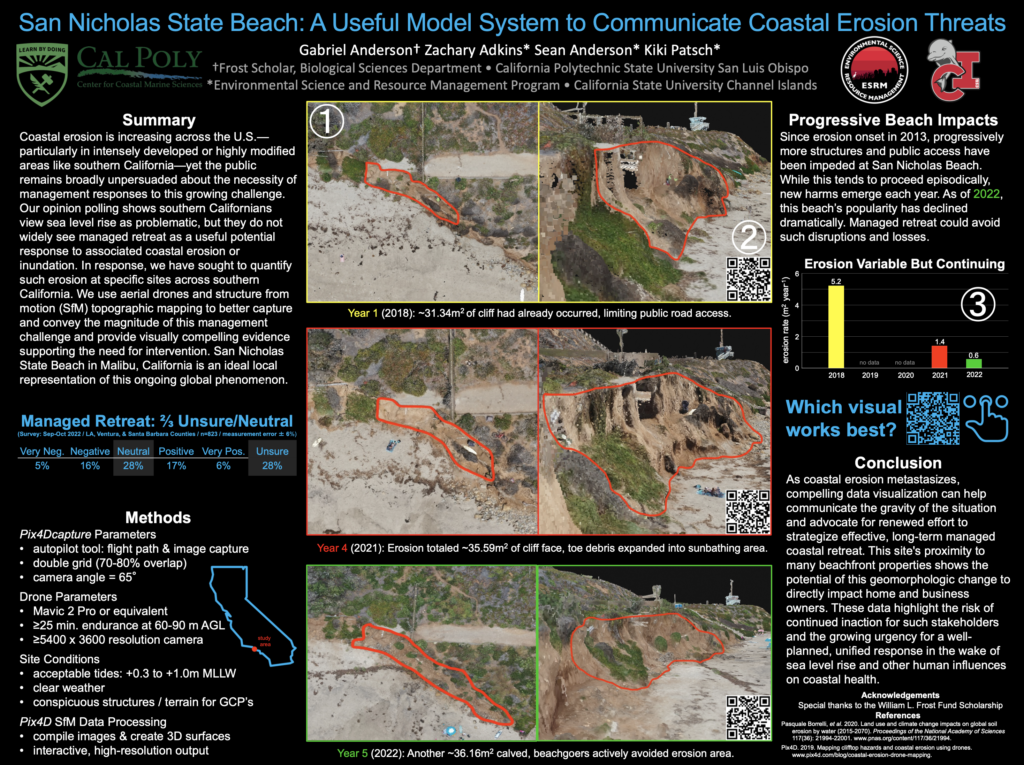
The Malibu Coast may serve as a useful example to illustrate the necessity of making management decisions sooner rather than later. For example, sea cliff erosion at San Nicholas State Beach has been increasing annually since we began monitoring that site in 2018. Erosion at this location has impacted access and state park infrastructure, but easily could have impacted homes were this private property. San Nicholas might be a useful model system with which to communicate the urgency of coastal erosion. I presented posters on the relevance of this site’s results at the 2021 and 2022 Western Society of Naturalists’ (WSN) conference, both over the internet and in-person.
